Saturday, October 26, 2019

Villa Romana del Casale

The highlight of the trip so far, by far, is the Villa Romana del Casale, an early 4th century AD villa near to the hill town of Piazza Armerina.  The owners identity has long been discussed and it was thought to be the villa of an Imperial owner such as Roman Emperor Maximian. However scholars now believe that it was the villa of a high level Senatorial aristocrat. It was built on top of the ruins of a 2nd century AD building and the proportions of the villa are enormous.

It was inhabited for at least 150 years and then taken over by attacking forces and eventually by the Normans in the middle ages.  It was abandoned 800 years later in about 1200 AD and (fortuitously for us in the modern era) buried by a mudslide so the villa and its elaborate mosaic floors are well preserved.  The mosaic floors were designed and built by African artisans in either a popular pattern from the time or in a scene that depicts a fictional story or a common activity.  One of the most famous of the mosaics is the Bikini Girls, which shows eight women in an athletic competition.  The mosaic was so well done that the face detection feature on my camera was finding the faces of the girls.


Portion of the villa leading to the baths.


The heated Gymnasium


Closeup of the tiles, which we were allowed to walk on


Fishing scene showing fisherman line fishing, using a net, harpoon and fish traps


A hunting scene when they released the dogs to chase the quarry. Two men carry a boar while two others study birds in a tree.


The great hunt, an enormous mosaic running the entire length of the room.


The great hunt capturing lions, elephants, camels and various other animals that will be shipped to Rome for use in the Coliseum during the games.


Entrance to a private room with the Bikini Girls mosaic floor


The Bikini Girls participating in various competitive sports. The woman on the bottom left is offering a crown and a victors palm frond to the winner.


The great hunt.


Four boys in a pretend athletic competition using chariots pulled by trained ostriches


Erotic scene


Tom reading his new book about the villa and absorbing all of the history possible


Piazza Armerina

The hill town of Piazza Armerina 


 A typical steep narrow street.  Brian drove down this one and a few others like it, unscathed.


Thursday, October 24, 2019

Selinunte Greek Ruins, Sicily

We arrived in Palermo after a short flight from Malta. Brian picked up our rental car (Fiat Panda) that would carry us about 300 miles along the southern end of the island of Sicily. Our plan was to drop off the car at the end of our vacation in Catania and fly to Amsterdam from there and the next day to board our Delta flight for the ten hour trip to Portland.


On with our story of the trip...........

In 1693 a 7.4 earthquake that lasted for four minutes struck southern Sicily. The destruction was massive and destroyed almost all of the ancient buildings that had stood for centuries. More than 60,000 people died. When rebuilding eventually began the decision was made to rebuild in the Baroque style so popular at that time. It is remarkable that some of the most ancient Greek and Roman structures survived. 

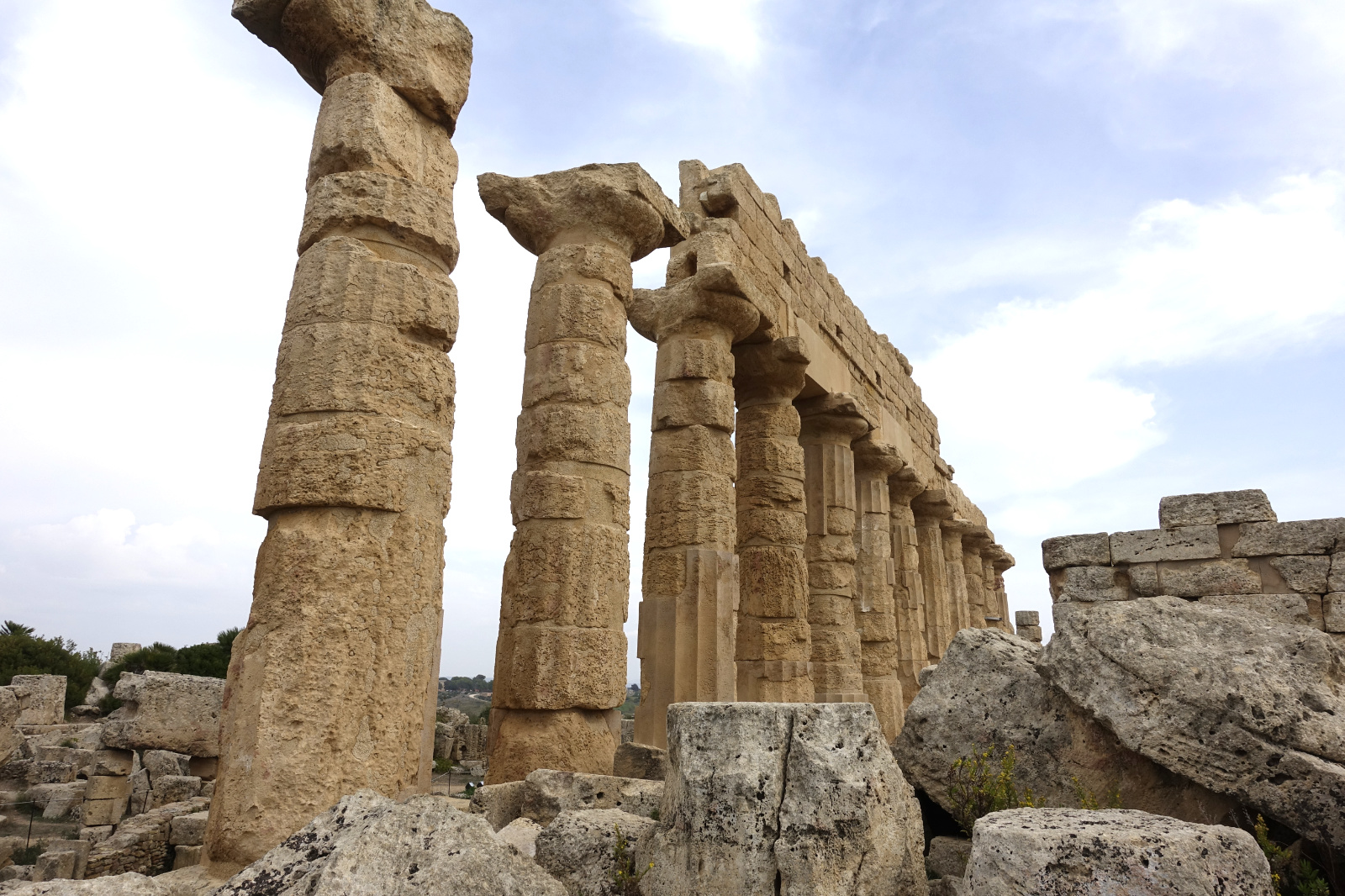
These are the Greek ruins at Selinunte in southern Sicily.  They date from the sixth century BC and pre-date the Romans. This temple was dedicated to the Greek god Hera. It was part of a group of four temples clustered together but all the rest have fallen into a pile of boulders. The detail on the columns is amazing.  It’s easy to see the fluted edges that are still sharp and clear. 

There are a number of Greek ruins located here in this part of Sicily including the best one in the Valley of the Temples on Agrigento. Unfortunately on the day we were in Agrigento to see the temples the exhibit was closed so we missed it.  It was a big disappointment. We found consolation in the fact that we were able to view this temple at Selinunte.


The remnants of another temple, now only a few columns and boulders remain.


Monday, October 21, 2019

Victoria, Gozo, Malta

Victoria, or as it was known in ancient times as Rabat, was then and is still the capital city of Gozo, the second largest island of the Maltese archipelago.  It’s history is ancient and the buildings that exist in the city are very old. The apartment that we rented for two nights was in a 400-year-old building and it was really interesting and charming. The streets are narrow but they accommodate traffic traveling in one direction and the pedestrians simply step to the side allowing the vehicles to pass. 


One of the interesting features of Gozo is the fact that people like bright colors and often paint their doorway and sometimes the window frames as such colors. The streets are basically cobblestone or brick with a narrow sidewalk on either side. Ornate door knockers are on many of the doors. It’s as if each person was vying with their neighbor to have the best entrance way.


Doorways and entranceways are often decorated with potted plants or some other type of shrubbery. Nowhere in Gozo did we see grass or trees within the city. Shown below is our 400 year old apartments that we enjoyed for two nights. It was constructed  about the year 1600.


 View of St. George’s Cathedral from the Cittadella. (Citadel or Duomo)  We stayed right next to it.


The Knights of St. John, also known as the Knights of Malta, used the citadel shown below as their lodging and defense against attacking forces. The citadel dates prior to 1530 but was fortified to its current structure in response to repeated attacks that exposed inadequate defenses. Today it is open to tour and to enjoy several museums within the citadel. The Cathedral of the Assumption is located within the citadel as well, it was constructed in the late 1700s.  This part of the world is strongly Catholic and there are many ornate and majestic churches everywhere.  They continue to be in use today everywhere just as they have for centuries.

The Knights of Saint John were finally utterly defeated by an attack from Napoleon Bonaparte‘s forces on the island of Malta. Napoleon sent 30,000 soldiers and 10,000 sailors to eliminate the order of the knights. They never recovered and have faded into history.


Various fishing nets hanging within the citadel.


The ruins within the Cittadella


Gozo

Gozo is the second largest island of the Maltese archipelago.  While the main island of Malta is heavily congested with traffic this island is much more laid-back and visitor friendly for walking through the narrow streets of the village. It was refreshing to visit and there was much to see. It’s a beautiful spot in the Mediterranean. We took an open air bus tour around the island and got a really good feel for it. All of the small towns were built on hills or right on the edge of the Mediterranean Sea.  Almost every one of the small hill towns has a large church that punctuates its landscape.  There is no natural source of water on the island. They are entirely dependent on rainfall and imported water. When it rains the water soaks into the ground through several different levels of sediment until it hits a level of blue clay which stops the water from going any further into the earth. From there they have the option to pump the water back out of the ground for use. We enjoyed our visit to Gozo very much and would recommend it to anyone visiting this area.

View from the ferry


Mgarr marina at Gozo


The remnants of an ancient Roman aqueduct


Fort built for defense of Gozo harbor by the Knights of Malta


The Ggantija Temples were built between 3600 to 3000 BC and were thought for centuries to have been built by a mythical race of giants. They were discovered in the early part of the 20th century and have been partially restored to preserve their condition as much as possible, evidenced by the scaffolding erected on part of the structure.


This is thought to have been an altar for offerings to the gods.


Figurines found at the site with the body of a snail and the head of a human.


Summary

It was a great trip to this small corner of the world.  We started in Malta and you can see on the map how tiny the country is.  Gozo is the...